
Raketenstarts weltweit
Startkalender
Die nächsten 25 Raketenstarts weltweit, alle Zeiten in mitteleuropäischer Zeit (MESZ, UTC+2 im Sommer). Zum Aufklappen auf einen Start klicken. Termine verschieben sich in der Raumfahrt häufig und kurzfristig.
16.07.2026 · 22:32 Uhr MESZ Falcon 9 Block 5 | SDA Tranche 1 Transport Layer E Go
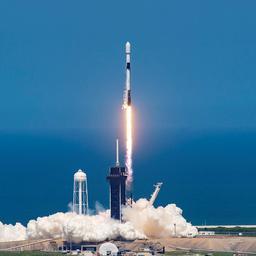
Tranche 1 Transport Layer E is one of six missions by the United States Space Force Space Development Agency (SDA) for the Proliferated Warfighter Space Architecture (PWSA) Tranche 1 Transport Layer constellation, which will provide assured, resilient, low-latency military data and connectivity worldwide to the full range of warfighter platforms from Low Earth Orbit satellites. The constellation will be interconnected with Optical Inter-Satellite Links (OISLs) which have significantly increased performance over existing radio frequency crosslinks. It is expected to operate over Ka band, have stereo coverage and be dynamically networked for simpler hand-offs, greater bandwidth and fault tolerance. This launch carries 21 satellites manufactured by York Space Systems.
17.07.2026 · 00:45 Uhr MESZ Starship | Flight 13 Go

13th test flight of the two-stage Starship launch vehicle. Second flight of Starship V3. For the first time, Starship will carry 20 V3 Starlink satellites to space, which will extend solar arrays and antennas and will attempt to connect with ground stations in South Africa and the larger Starlink constellation via high-capacity lasers. 6 of the satellites have been modified with a suite of cameras to scan Starship’s heat shield and transmit imagery down to operators to continue testing methods of analyzing Starship’s heat shield readiness for return to launch site on future missions. Several tiles on Starship have been painted white to simulate missing tiles and serve as imaging targets in the test.
17.07.2026 · 13:50 Uhr MESZ Long March 7A | Unknown Payload Go
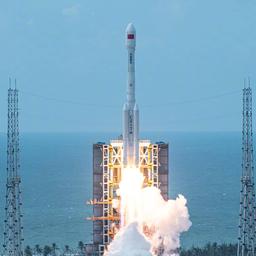
Details TBD.
18.07.2026 · 07:00 Uhr MESZ Vikram-I | Demo Flight TBC

First launch of Skyroot Aerospace’s Vikram-I launch vehicle, with several cubesats on board. Payload identities TBD.
20.07.2026 · 16:00 Uhr MESZ Falcon 9 Block 5 | Starlink Group 17-39 Go
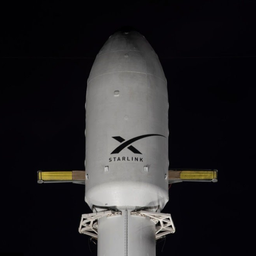
A batch of 24 satellites for the Starlink mega-constellation – SpaceX’s project for space-based Internet communication system.
21.07.2026 · 23:15 Uhr MESZ Falcon 9 Block 5 | MRV-1 Go
The SpaceLogistics MRV-1 is a mission extension payload including a mission robotic vehicle (MRV) and multiple mission extension pods (MEPs).
23.07.2026 · 13:00 Uhr MESZ Long March 3B/E | Unknown Payload TBC
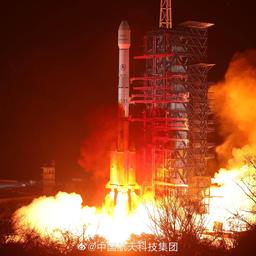
Details TBD.
24.07.2026 · 13:00 Uhr MESZ Long March 8A | Unknown Payload TBC
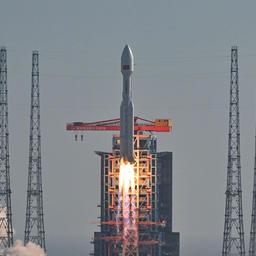
Details TBD.
24.07.2026 · 16:00 Uhr MESZ Falcon 9 Block 5 | Starlink Group 17-51 Go
A batch of 24 satellites for the Starlink mega-constellation – SpaceX’s project for space-based Internet communication system.
31.07.2026 · 02:00 Uhr MESZ (Termin ungenau) Electron | LOXSAT 1 TBD
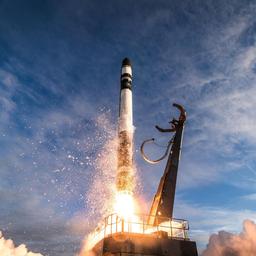
LOXSAT 1 is a demonstration satellite of a complete cryogenic oxygen fluid management system in orbit, developed by Eta Space and sponsored by NASA’s Tipping Point program. The system will be integrated on a Rocket Lab Photon-LEO satellite bus and collect critical cryogenic fluid management data in orbit for 9 months, demonstrating capabilities of in-space cryogenic storage and transferal. Eta Space plans to use technology developed for this mission to develop a truly commercial depot intended to serve multiple customers in the future.
31.07.2026 · 02:00 Uhr MESZ (Termin ungenau) Electron | StriX Launch 11 TBD
Synthetic aperture radar satellite for Japanese Earth imaging company Synspective.
31.07.2026 · 02:00 Uhr MESZ (Termin ungenau) Electron | The Grain Goddess Provides (iQPS Launch 7) TBD
Synthetic aperture radar Earth observation satellite for Japanese Earth imaging company iQPS.
31.07.2026 · 02:00 Uhr MESZ (Termin ungenau) Falcon 9 Block 5 | Globalstar 2-R Mission 1 (x 9) TBD
The Globalstar global mobile communications network offers global, digital real time voice, data and fax services via its Low Earth Orbit satellite constellation. The constellation operates in a 1410 km orbit inclined at 52 degrees. In early 2022, Globalstar contracted with MDA for the construction of 17 new 2nd generation refresh satellites to replenish the existing constellation. Rocket Lab is sub-contracted to build the satellites‘ buses and the launch dispensers.
31.07.2026 · 02:00 Uhr MESZ (Termin ungenau) Gravity-1 | Unknown Payload TBD
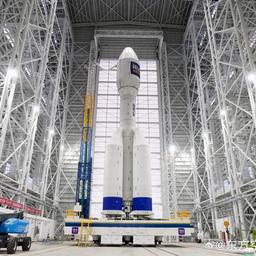
Details TBD.
31.07.2026 · 02:00 Uhr MESZ (Termin ungenau) GSLV Mk II | GISAT-1A (EOS-05) TBD
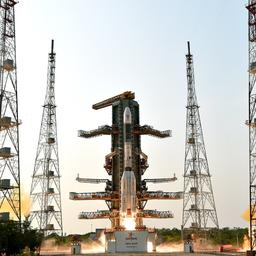
GISAT-1A (GEO Imaging Satellite) is an Indian earth observing satellite operating from geostationary orbit to facilitate continuous observation of Indian sub-continent, quick monitoring of natural hazards and disaster.
31.07.2026 · 02:00 Uhr MESZ (Termin ungenau) Mir | Demo Flight TBD
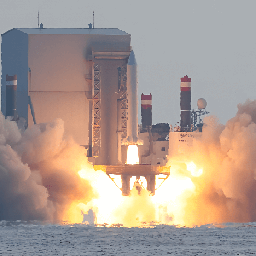
Note: Launch vehicle name is provisional. First orbital full version launch of the South Korean military small satellite launch vehicle, after 2 sub-orbital tests of individual stages on 30 March and 30 December 2022, and 1 orbital test flight without the 2nd stage on 4 December 2023. Details TBD.
31.07.2026 · 02:00 Uhr MESZ (Termin ungenau) Soyuz 2.1b | 16 x Rassvet-3 TBD
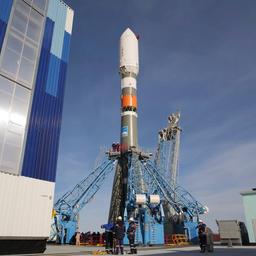
Note: Payload identities uncertain. Batch of 16 Rassvet-3 Low Earth Orbit communication satellites for the Russian Byuro-1440 (Bureau 1440) constellation for broadband high-speed internet access in Russia.
06.08.2026 · 02:00 Uhr MESZ (Termin ungenau) Spectrum | Onward and Upward TBD
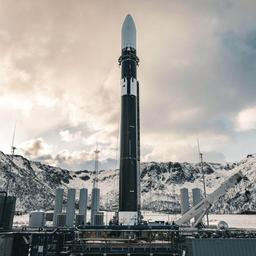
Second test flight of the Isar Spectrum launch vehicle. This launch will carry 5 cubesats and 1 non-separable experiment as part of European Space Agency (ESA)’s “Boost!” program: * CyBEEsat (TU Berlin) * TriSat-S (University of Maribor) * Platform 6 (EnduroSat) * FramSat-1 (NTNU) * SpaceTeamSat1 (TU Wien Space Team) * Let It Go (Dcubed, non-separable experiment)
06.08.2026 · 21:30 Uhr MESZ H3-22 | Michibiki 7 (QZS-7) Go
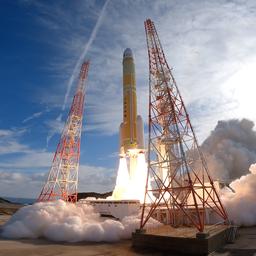
QZSS (Quasi Zenith Satellite System) is a Japanese satellite navigation system operating from inclined, elliptical geosynchronous orbits to achieve optimal high-elevation visibility in urban canyons and mountainous areas. The navigation system objective is to broadcast GPS-interoperable and augmentation signals as well as original Japanese (QZSS) signals from a three-spacecraft constellation. The navigation system objective is to broadcast GPS-interoperable and augmentation signals as well as original Japanese (QZSS) signals from a three-spacecraft constellation in inclined, elliptical geosynchronous orbits.
27.08.2026 · 02:00 Uhr MESZ (Termin ungenau) Ariane 62 | MTG-I2 TBD
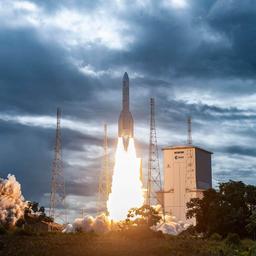
Third of EUMETSAT’s third generation of weather satellite.
30.08.2026 · 02:00 Uhr MESZ (Termin ungenau) Falcon Heavy | Nancy Grace Roman Space Telescope TBD
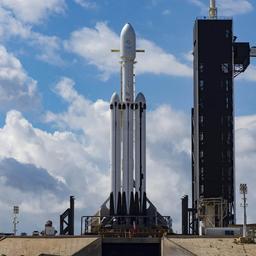
The Nancy Grace Roman Space Telescope is a NASA infrared space telescope with a 2.4 m (7.9 ft) wide field of view primary mirror and two scientific instruments. The Wide-Field Instrument (WFI) is a 300.8-megapixel multi-band visible and near-infrared camera, providing a sharpness of images comparable to that achieved by the Hubble Space Telescope over a 0.28 square degree field of view, 100 times larger than imaging cameras on the Hubble. The Coronagraphic Instrument (CGI) is a high-contrast, small field of view camera and spectrometer covering visible and near-infrared wavelengths using novel starlight-suppression technology. Roman objectives include a search for extra-solar planets using gravitational microlensing, and probing the expansion history of the Universe and the growth of cosmic structure, with the goal of measuring the effects of dark energy, the consistency of general relativity, and the curvature of spacetime.
31.08.2026 · 02:00 Uhr MESZ (Termin ungenau) Falcon 9 Block 5 | BlueBird Block 2 #6-8 TBD
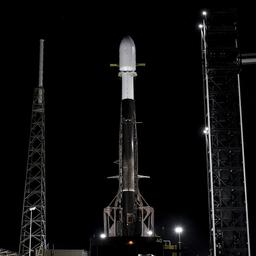
AST SpaceMobile’s Block 2 BlueBird satellites are designed to deliver up to 10 times the bandwidth capacity of the BlueBird Block 1 satellites, required to achieve 24/7 continuous cellular broadband service coverage in the United States, with beams designed to support a capacity of up to 40 MHz, enabling peak data transmission speeds up to 120 Mbps, supporting voice, full data and video applications. The Block 2 BlueBirds, featuring as large as 2400 square foot communications arrays, will be the largest satellites ever commercially deployed in Low Earth orbit once launched. This launch will feature 3 satellites.
31.08.2026 · 02:00 Uhr MESZ (Termin ungenau) Falcon 9 Block 5 | Dragon CRS-2 SpX-35 TBD
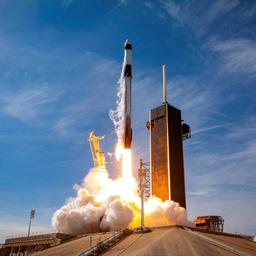
35th commercial resupply services mission to the International Space Station operated by SpaceX. The flight will be conducted under the second Commercial Resupply Services contract with NASA. Cargo Dragon 2 brings supplies and payloads, including critical materials to directly support science and research investigations that occur onboard the orbiting laboratory.
31.08.2026 · 02:00 Uhr MESZ (Termin ungenau) Falcon 9 Block 5 | SDA Tranche 2 Transport Layer A TBD
Classified mission launched by the Space Development Agency (SDA) for Tranche 2 Transport Layer.
31.08.2026 · 02:00 Uhr MESZ (Termin ungenau) Long March 5 | Chang’e 7 TBD
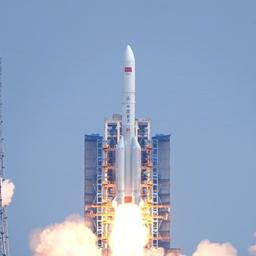
Chang’e 7/CE-7 is scheduled to launch in 2026, including an orbiter, a lander, a mini-hopping probe, and a rover. The mission will land in the South Pole regions of the Moon to study lunar surface environment around the South Pole, especially in looking for water ice in lunar soil.
Insgesamt sind derzeit 361 Starts in der Datenbank angekündigt. Diese Seite zeigt die nächsten 25.