
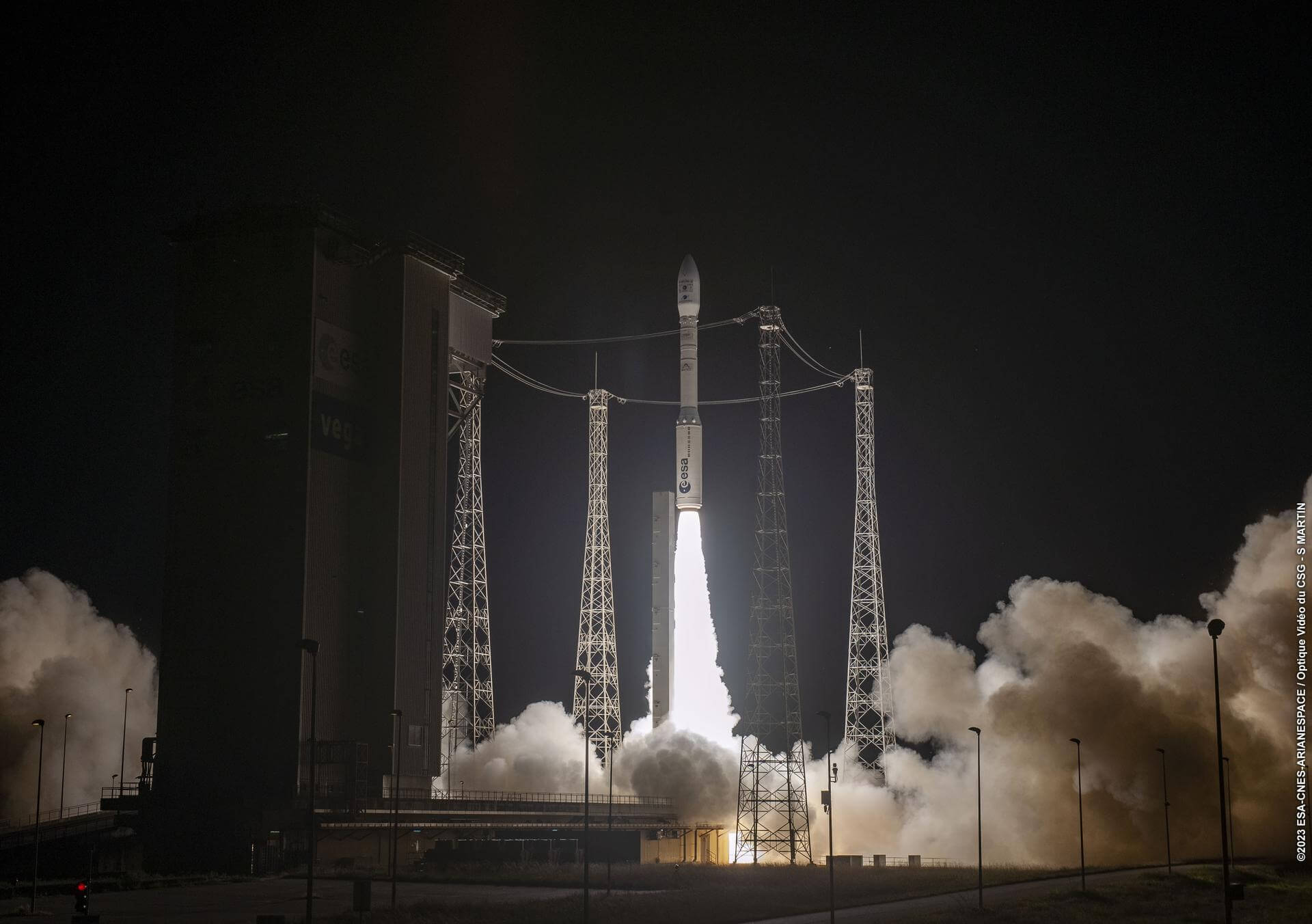
Vergangener Start
Vega | THEOS-2, TRITON & others
Erfolg 08.10.2023, 22:36 (Ortszeit am Startplatz)
THEOS-2 is Thailand’s first Earth observation satellite. Built by Airbus Defense and Space and based on the Astrobus-S platform, it is designed for optical measurements with a ground resolution of approximately 1 meter. TRITON or FORMOSAT-7R is an additional satellite by NSPO added to the joint Taiwanese-US FORMOSAT 7 / COSMIC-2 constellation for collecting atmospheric data for weather prediction and for ionosphere, climate and gravity research. Its GNSS Reflectometry payload can be used to calculate the wind speed over sea surfaces. Cubesats: PROBA-V-CC (Project for On-Board Autonomy - Vegetation - Companion CubeSat) (12U) is a mission that will fly a scaled-down version of the vegetation-monitoring instrument aboard the Earth-observing PROBA-V to conduct combined experimental observations with its predecessor. PRETTY (Passive REflecTomeTry and dosimetrY) (3U) flies a GPS/Galileo signal reflectometer and radiation monitor for Graz University of Technology of Austria. MACSAT (6U) is an In-orbit demonstration (IoD) missionto demonstrate IoT communication over 5G for OQTech. CSC-1 and 2 (6U) contains 7 different experimental payloads from various institutions being flown by ISISPACE/ISL. N3SS (Nanosat 3U pour la Surveillance du Spectre) (3U) is a demonstration system for detecting and localize radio-frequency jammers on civil spectrum for the French CNES. ESTCUBE-2 is a technology demonstration mission with multiple scientific payloads for University of Tartu of Estonia. ANSER LEADER/FOLLOWER 1/2 (Advanced Nanosatellite Systems for Earth observation Research) is a cluster of 3 Earth observing cubesats with panchromatic and hyperspectral cameras for Spain's INTA for monitoring the quality of inland (reservoirs) water over the Iberian Peninsula. (Original, deutsche Fassung folgt)
Vega
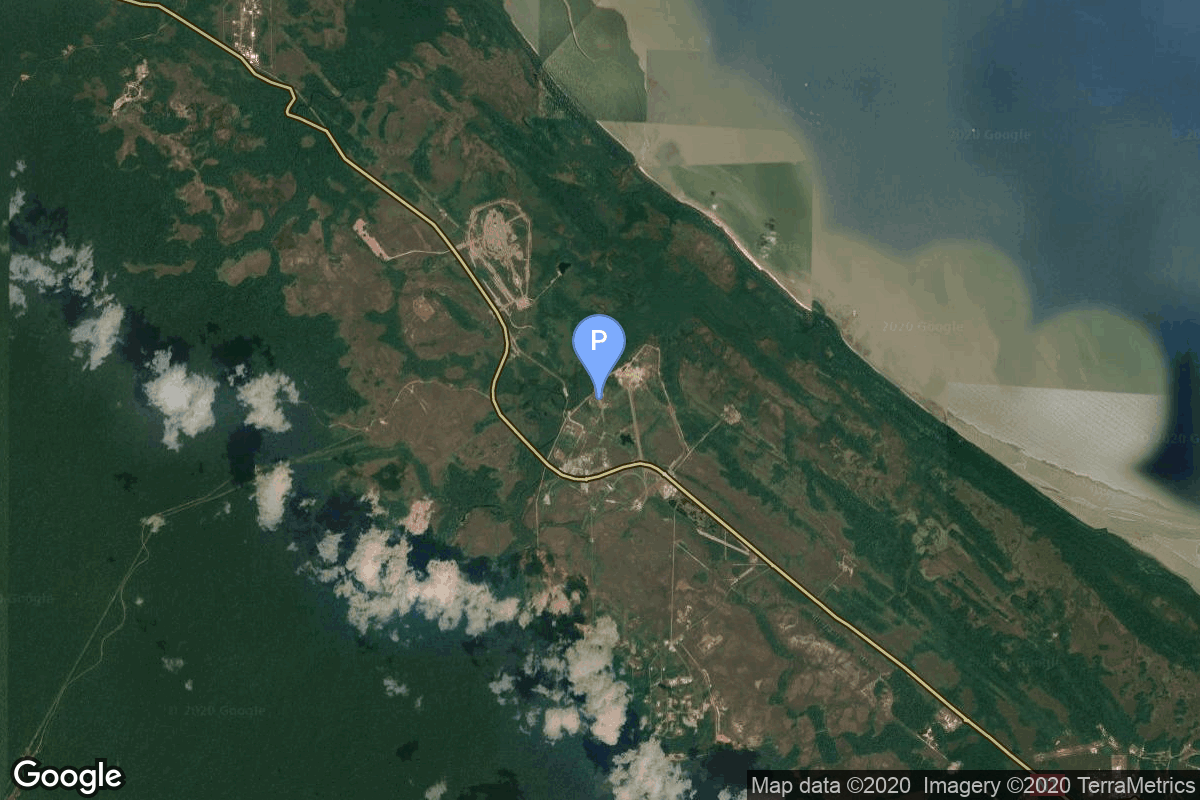 Karte laden (OpenStreetMap)
Kartenvorschau: The Space Devs · Interaktive Karte: OpenStreetMap (laedt erst nach Klick)
- 09.10.2023 Successful launch (Original, deutsche Fassung folgt)
- 09.10.2023 Abheben.
- 09.10.2023 Livestream has started (Original, deutsche Fassung folgt)
- 08.10.2023 Targeting October 9th at 1:36 UTC (Original, deutsche Fassung folgt)
- 07.10.2023 Delayed for additional checks. (Original, deutsche Fassung folgt)
- 07.10.2023 GO für den Start.
- 07.10.2023 Für heute abgesagt.
- 07.10.2023 Hold at T-14 seconds. (Original, deutsche Fassung folgt)
Quelle: Launch Library 2 (The Space Devs)
← Zurueck zum Startkalender · Zum Archiv